 |
|
|
| 15 March 2007 | Two Paintings Recently Sold Earlier in the year two paintings sold— Blue Hour: Accept and Blue Hour: Remember. Each of these exists from a series which helped The lack of warm colors strengthens the mood in each painting. Blue tones monopolize the viewer's perspective, heightening the the sense of loss. Harsh, painterly shadows control the internal motion, deconstructing the details within the background, and at the same time increasing a sense of claustrophobia. |
|
 |
 |
|
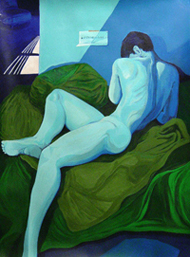 |
Remember began as a means of showing a male figure exposed to his surroundings, the model vulnerable, as if fallen into a state of grief. A note taped to the wall simply says "remember"—not as a command of action, but rather as a descriptive caption, a statement outlining the moment shown—a moment of sudden waking in the middle of the early morning, insomnia seizing the body, an awareness of a sudden grief. In addition, the figure mimics poses utilized by the Italian Renaissance masters, showing the body contorted and twisted in an uncomfortable posture. The goal for using an unnatural pose allows the body muscles to appear stressed; shadow play in turn shows off more curves and valleys of the form. In Remember, the model appears struggling to hide his face, refusing to reveal the intensity of his emotions, or allow a connection to be made between himself and the viewer. His self control results in self absorption and self exile. As a result, the observer can suggest their own storyline or personal experience to the piece. |
|
|
|
|
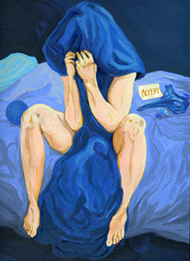 |
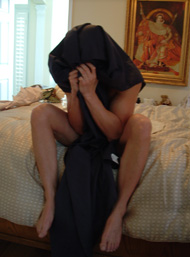
Accept takes this same concept to a different extreme, the main figure attempts to hide completely, wrap himself in a heavy fabric as a means of protection or become invisible. The dark blue sheet sheet represents the grief itself, a physical icon of the controlling moment of loss. It binds, acts as a restraint as it wraps tightly around the figure's form. Similar to the scene in Remember, a scrap of paper appears within the perimeter of the bed. In this case, the word "accept" exists as a note of contention. The male figure refuses to acknowledge its presence nor follow its instruction. Alongside the note, two stones exist, misplaced elements to the scene. They represent psychological archetypes, symbols of distress collected internally by individuals throughout their lives. The more stones gathered the stronger the internal turmoil, the burden ever increasing in weight. In turn, when adding these to the painting, I had in mind the King James translation of the book Ecclesiastes, from the Old Testament— |
 |
|
|
|
To every thing there is a season, and a time to every purpose under the heaven: ...A time to cast away stones, and a time to gather stones together.Ecc. 3:1-5 |
||
|
|
|
| Repeat visitors will recognize the qoute as the basis of my sketch site: www.agatheringofstones.com | ||
|
|
|
Subtle internal motion lies in the midground of the scene, with the mask pointing across the figure to a juggler's ball on the left side. The eye follows down and across once more to another ball slightly obscured in the shadows under the bed, which in turn sends the eye back to the mask. |
||
|
|
|
| Ars longa; vita brevis. | ||
|
||
| return to top |
